
A village that grew from 8,768 to 65,058 people in 20 years
Concrete Contractors in Arlington Heights, IL
Driveways, patios, walks and slabs for a home base where most houses went up between 1960 and 1990.
- Free estimates on site, including grade and drainage checks
- Line-item written pricing before work starts
- Compacted stone base, planned joints and a proper cure on each slab
Concrete Work Built Around Arlington Heights Homes
We are concrete contractors in Arlington Heights, and this is the village our site is named for. Arlington Heights covers about 16.6 square miles in northwest Cook County, and the 2020 census counted 77,676 residents in 33,356 housing units. Nearly every one of those homes has some concrete tied to it: a driveway and apron, a front walk, back steps, a patio, a garage floor. Most of that concrete was poured during one big wave of building, and much of it is now reaching the age where it needs attention.
The building boom behind today's repairs
The census tells the story plainly. Arlington Heights had 8,768 people in 1950, 27,878 in 1960 and 65,058 in 1970. After that the count leveled off, reaching 75,460 in 1990 and 77,676 in 2020. Housing data from the American Community Survey (2019-2023, as reported by Point2Homes) lines up with it: 21.7% of homes were built in the 1960s, 22.7% in the 1970s and 17.8% in the 1980s. The median year built is 1974.
That matters for concrete because flatwork does not last as long as the house. A driveway poured with the original home in 1974 has been through about fifty Illinois winters. Some of those slabs are still sound and only need sealing or a few joint repairs. Others have settled at the garage, heaved at the apron, or started to scale where salt sat on the surface. Part of our job is telling you which group your concrete falls into.
What fifty winters do to a slab
Wikipedia's climate table for the village lists a record low of minus 26 degrees and a record high of 105 degrees, with about 38 inches of precipitation a year. Water gets into concrete, freezes, expands and thaws again many times each winter. Over decades that cycle opens up hairline cracks and pops the top layer off weaker surfaces. Older slabs that were poured without enough entrained air, or finished while bleed water was still on top, show it first.
When we pour new concrete in Arlington Heights we use an air-entrained mix, a compacted gravel base and control joints cut to the right depth and spacing. Those three things do more for a slab's lifespan than any coating added later. We also let the concrete cure properly before it sees traffic or deicers.
Water has to go somewhere
Arlington Heights handles stormwater on purpose. Lake Arlington, in the north part of the village, is a human-made, 50-acre detention lake inside a 93-acre park that also holds 11 acres of wetland. On a single lot the same principle applies at a smaller scale. A patio or driveway that pitches toward the house sends rain and snowmelt straight at the foundation. When we form a new slab we set the grade so water runs away from the walls and toward the yard or street, and we look at where downspouts land before we pour.
Permits and village standards
The village's residential permits page sends homeowners to the Building & Life Safety Department, on the first floor of Village Hall at 33 S. Arlington Heights Road. Its Driveway - Residential and Flatwork - Residential handouts set the build: 4 inches of concrete on 4 inches of compacted CA-6 for a private drive, 6 inches where the approach and public walk cross it, no pea gravel or sand under any exterior slab, and stoops on 42-inch-deep trench footings or piers. Every flatwork job gets a pre-pour base inspection and a final, and the forms must be pulled and the edges backfilled before that final. Public Works & Engineering also publishes standard details for the residential driveway apron and the sidewalk. We confirm what your project needs before a pour date goes on the calendar.
How our six services fit Arlington Heights homes
- Concrete driveways: full tear-out and replacement for original 1960s and 1970s drives, with a new apron built to the village detail
- Concrete patios: new slabs or larger replacements for small original patios
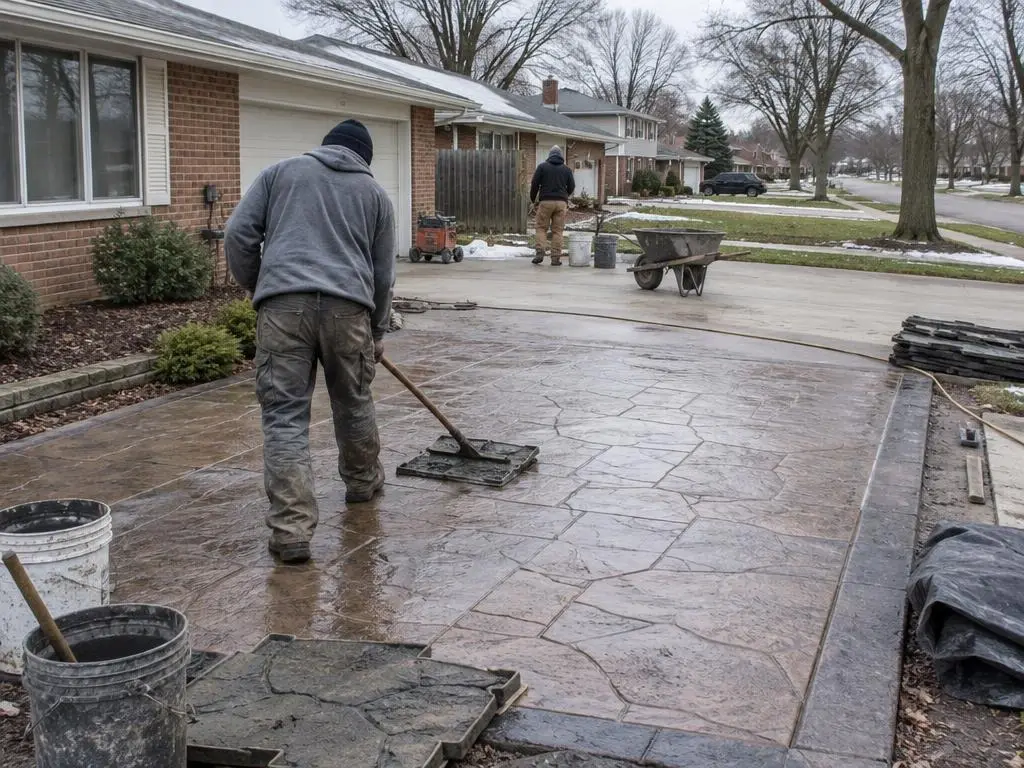
- Stamped concrete: patterned and colored patios and walks for owners who want the look of stone with one continuous slab
- Sidewalks & steps: front walks, service walks and steps that have sunk or cracked into trip hazards
- Garage & shed slabs: new floors for detached garages and pads for sheds, with a proper base under them
- Concrete repair & replacement: crack repair, joint sealing and a straight answer on when a slab is past fixing
Getting an estimate
We come out, measure, look at the slab and the drainage around it, and give you a written estimate with the scope spelled out. If a repair will buy you years, we say so. If the base has failed and the slab keeps moving, we explain why replacement is the better spend. Call (224) 494-2266 or request an estimate online.
What to Know in Arlington Heights
- Housing age. Per 2019-2023 ACS data on Point2Homes, 62% of homes were built in the 1960s, 1970s or 1980s. The median year built is 1974.
- Postwar growth. The census count rose from 8,768 in 1950 to 65,058 in 1970, then to 77,676 by 2020.
- Lake Arlington. A human-made, 50-acre detention lake in a 93-acre park, built to hold stormwater, with 11 acres of wetland.
- Weather range. Wikipedia lists a record low of minus 26°F, a record high of 105°F and about 38.25 inches of precipitation a year.
- Who handles permits. The village points residents to the Building & Life Safety Department at Village Hall for permit needs.
Our Services in Arlington Heights, IL
Arlington Heights Questions
Do I need a permit to replace my driveway in Arlington Heights?
Yes. The village lists a Driveway - Residential permit for replacement and repair. The submittal includes the contractor's proposal and a plat of survey, review typically takes about 10 business days, and the job needs a pre-pour base inspection and a final. We prepare the paperwork and book both inspections.
My driveway is from the 1970s. Should I repair it or replace it?
It depends on the base. Surface cracks and open joints on a slab that is still level can often be sealed or repaired. If sections have sunk, tilted toward the garage or heaved at the apron, the base underneath has usually failed and replacement is the longer-lasting fix.
When is the season for pouring concrete in Arlington Heights?
Most flatwork is poured from spring through fall, when the ground is not frozen and nights stay above freezing long enough for the concrete to cure. Late-season pours need blankets and close watching, so we plan around the forecast.
Free Estimates in Arlington Heights, IL
Free concrete estimates anywhere in Arlington Heights.
Concrete Contractors Near Arlington Heights
- Concrete Contractors in Mount Prospect, IL
- Concrete Contractors in Palatine, IL
- Concrete Contractors in Rolling Meadows, IL
- Concrete Contractors in Prospect Heights, IL
- Concrete Contractors in Buffalo Grove, IL
- Concrete Contractors in Wheeling, IL
- Concrete Contractors in Des Plaines, IL
- Concrete Contractors in Elk Grove Village, IL
- Concrete Contractors in Schaumburg, IL
- Concrete Contractors in Hoffman Estates, IL
- Concrete Contractors in Park Ridge, IL
- Concrete Contractors in Glenview, IL
- Concrete Contractors in Northbrook, IL
- Concrete Contractors in Barrington, IL
- Concrete Contractors in Streamwood, IL
- Concrete Contractors in Lake Zurich, IL
- Concrete Contractors in Inverness, IL
- Concrete Contractors in Long Grove, IL
- Concrete Contractors in Niles, IL
- Concrete Contractors in Vernon Hills, IL
- Concrete Contractors in Deerfield, IL
- Concrete Contractors in Lincolnshire, IL