
Driveway replacement, aprons and widening
Concrete Driveways in Arlington Heights, IL
A new driveway on a real base, thick where the Village says it must be, jointed and cured for winter.
- Free estimates on site, including grade and drainage checks
- Line-item written pricing before work starts
- Compacted stone base, planned joints and a proper cure on each slab
Replacing the Driveways the Boom Years Left Behind
Concrete driveways are the biggest single piece of concrete on most Arlington Heights lots, and many of them are worn out. Census survey figures summarized by Point2Homes show that more than half of local homes were built between 1950 and 1979. A driveway poured with the house has now been through 45 to 75 Illinois winters, plus decades of salt and tire traffic. When it cracks through, sinks at the garage or apron, or sheds its surface in flakes, patching usually buys only a season or two. A full replacement on a proper base starts the clock over.
Signs it is time for a new driveway
- Cracks that run all the way across the slab, often with one side higher than the other
- A section that has sunk at the garage door, creating a lip or a puddle
- The apron dropped or broken where it meets the street
- Scaling: the top layer flaking off, leaving rough, pitted concrete
- Water that runs toward the house or garage instead of away from it
- Old patches that have broken loose again
What the Village requires
Arlington Heights publishes specific driveway standards, and every driveway we pour in the village meets them:
- Private driveway: at least 4 inches of concrete on 4 inches of compacted CA-6 gravel. Wire mesh is optional.
- Approach (apron) and sidewalk crossing: at least 6 inches of concrete on 2 inches of compacted CA-6, with no wire mesh.
- Mix: at least a 6.1 bag mix, Class PV or equivalent, for the driveway, approach and sidewalk.
- Base: pea gravel and sand are not allowed under exterior concrete.
- Joints: a 6 by 1/2 inch expansion joint between the sidewalk and the driveway approach.
- Width: a driveway for a one- or two-car garage must be between 9 and 22 feet wide. A three-car garage may be up to 32 feet wide within 18 feet of the garage front, tapering to 22 feet. The apron can be up to 22 feet wide at the curb, with up to a 3-foot flare on each side.
- Inspections: a base inspection before the pour and a final inspection after the forms come out.
The Village also caps paved surfaces in the front yard at 50% and, on lots 70 feet wide or more, requires the driveway to stay at least 3 feet from the side lot line. An existing driveway that is wider than today's limits can generally be replaced in kind, as long as the nonconformity does not grow. We check this against your plat of survey before quoting.
How we build it
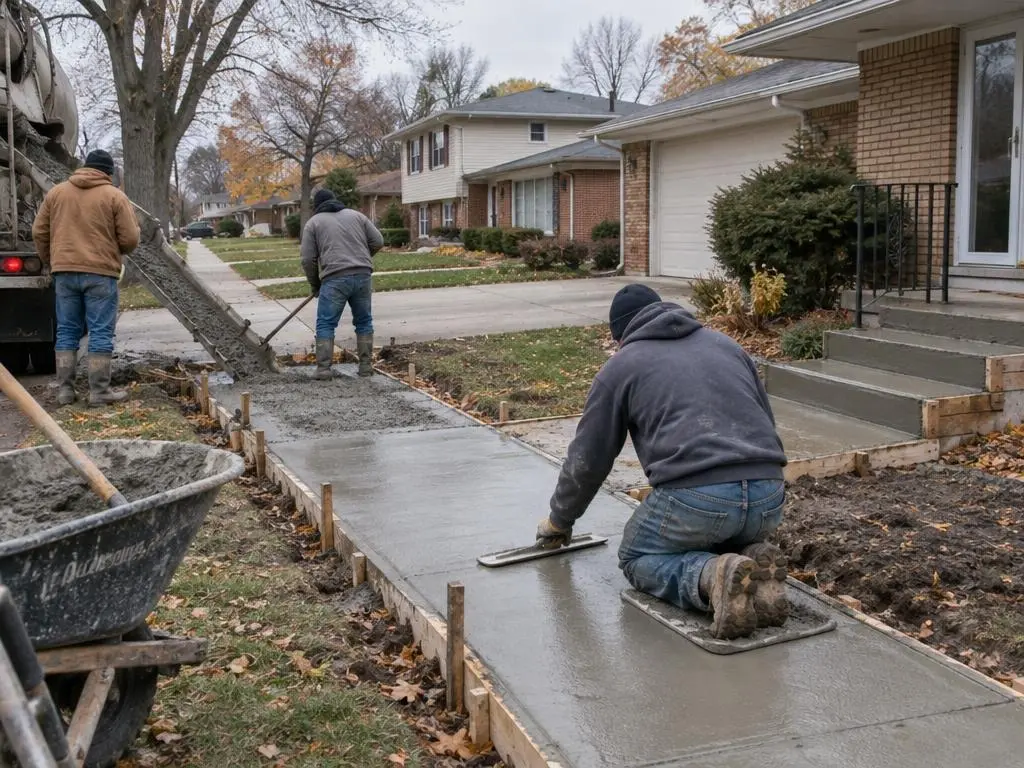
We saw-cut a clean line where the new concrete meets anything staying, break out the old slab and haul it away. Then we dig out soft soil, bring in crushed stone and compact it in layers. Forms set the grade so water drains toward the street or the yard, not the garage. Exterior concrete is air-entrained so it can take freeze-thaw cycles, and we finish it with a broom texture for grip on wet and icy days. Control joints are tooled or saw-cut at even spacing, and the slab is cured so the surface keeps enough moisture to gain strength.
Finish options
- Broom finish: the standard. Simple, grippy and the least expensive.
- Exposed aggregate: the top layer is washed off to show the stone. Good traction and hides tire marks.
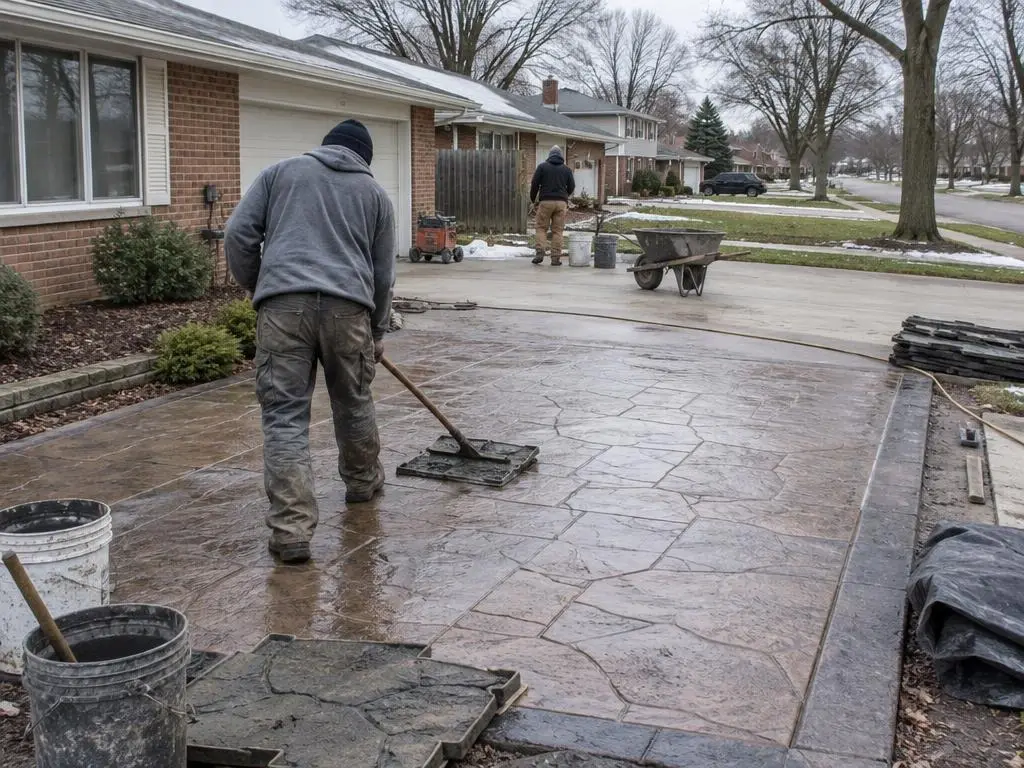
- Stamped or colored borders: a decorative band along the edges with a plain broom field in the middle.
- Integral color: a tint mixed through the whole slab so the color does not wear off.
If the driveway sees heavy vehicles, we may suggest a thicker slab or rebar in addition to the Village minimums.
Caring for a new driveway
Keep cars off it until we say it is ready, usually about a week. In the first winter, avoid de-icers entirely if you can and use sand for traction. After that, use salt sparingly, never use products with ammonium nitrate or ammonium sulfate, and shovel snow off rather than letting salty slush sit. Sealing the surface every few years helps keep water and salt out. HomeGuide lists sealing at $1 to $3 per square foot.
What a Driveway Replacement Covers
A full driveway job runs from the garage slab edge to the street curb, including the public sidewalk crossing.
Removal and haul-away
The old slab broken out, loaded and hauled off, with clean saw cuts where new concrete meets old.
Base preparation
Soft soil dug out and crushed CA-6 stone placed and compacted to the depth the slab needs.
Driveway apron
The approach between the sidewalk and the street, poured 6 inches thick with expansion joints at the curb and walk.
Sidewalk crossing
The section of public walk that runs through the driveway, poured to the thicker standard and the 2% cross slope limit.
Widening
Extra width added within the Village's limits for a second car or easier turning.
Drainage corrections
Regraded slope or a side curb to steer water to the street or rear yard instead of the garage.
Typical Concrete Driveway Costs
| Driveway | Published range |
|---|---|
| Per square foot, standard concrete installed | $6 to $15 |
| One-car, 12 x 24 ft (288 sq ft) | $1,700 to $4,300 |
| Two-car, 20 x 20 ft (400 sq ft) | $2,400 to $6,000 |
| Two-car, 24 x 24 ft (576 sq ft) | $3,500 to $8,600 |
| Removing the old driveway | $2 to $6 per sq ft |
| 6-inch slab | $8 to $20 per sq ft |
| Sealing | $1 to $3 per sq ft |
National ranges from HomeGuide's concrete driveway cost guide. Northwest suburban prices can differ, and removal, base depth, thicker aprons, drainage work and finish all change the total. Your written estimate is the price.
How It Works
1. Measure and plan
We measure, check slope and drainage, and confirm width and setbacks against your plat of survey.
2. Permit
In Arlington Heights we submit the driveway permit; elsewhere we follow that town's process.
3. Tear out and base
The old slab comes out, the base is built and compacted, and the base inspection is done.
4. Pour and cure
We pour, finish, cut joints and cure the slab, then remove forms and backfill for the final inspection.
Concrete Driveways Questions
How long does a driveway replacement take?
The tear-out, base and pour usually take a few days, depending on size and weather. Add the curing time before you drive on it, usually about a week. Permit review in Arlington Heights typically takes about 10 business days, so that comes first.
Can you just pour over my old driveway?
Only if the old slab is sound and level, and even then raised height at the garage and apron causes problems. Most old driveways here are cracked through or sunken, and those cracks carry up through an overlay. Removal and a new base is usually the right call.
Do I need rebar or wire mesh?
The Village makes mesh optional on private driveways and does not allow it in the approach or sidewalk crossing. A good base and proper joints matter more than mesh. We add rebar where loads or soil conditions call for it.
Can I make my driveway wider?
Often, yes. For a one- or two-car garage the Village allows up to 22 feet, and up to 32 feet near a three-car garage. Front-yard paving is capped at 50% of the yard. We check your lot before we quote.
Why is my driveway flaking?
That is scaling, usually from freeze-thaw cycles combined with de-icing salt, often on concrete that was overworked, too wet or poorly cured when poured. Once it spreads across the slab, replacement is the lasting fix.
Concrete Driveways Service Areas
- Concrete Contractors in Arlington Heights, IL
- Concrete Contractors in Mount Prospect, IL
- Concrete Contractors in Palatine, IL
- Concrete Contractors in Rolling Meadows, IL
- Concrete Contractors in Prospect Heights, IL
- Concrete Contractors in Buffalo Grove, IL
- Concrete Contractors in Wheeling, IL
- Concrete Contractors in Des Plaines, IL
- Concrete Contractors in Elk Grove Village, IL
- Concrete Contractors in Schaumburg, IL
- Concrete Contractors in Hoffman Estates, IL
- Concrete Contractors in Park Ridge, IL
- Concrete Contractors in Glenview, IL
- Concrete Contractors in Northbrook, IL
- Concrete Contractors in Barrington, IL
- Concrete Contractors in Streamwood, IL
- Concrete Contractors in Lake Zurich, IL
- Concrete Contractors in Inverness, IL
- Concrete Contractors in Long Grove, IL
- Concrete Contractors in Niles, IL
- Concrete Contractors in Vernon Hills, IL
- Concrete Contractors in Deerfield, IL
- Concrete Contractors in Lincolnshire, IL
Get a Concrete Driveways Estimate
Free on-site estimates for driveway replacement in Arlington Heights and nearby suburbs.