
Once nicknamed Brickton for its clay
Concrete Contractors in Park Ridge, IL
Careful flatwork for one of the oldest housing stocks in the area, built on clay that once fed Chicago's brickyards.
- Free estimates on site, including grade and drainage checks
- Line-item written pricing before work starts
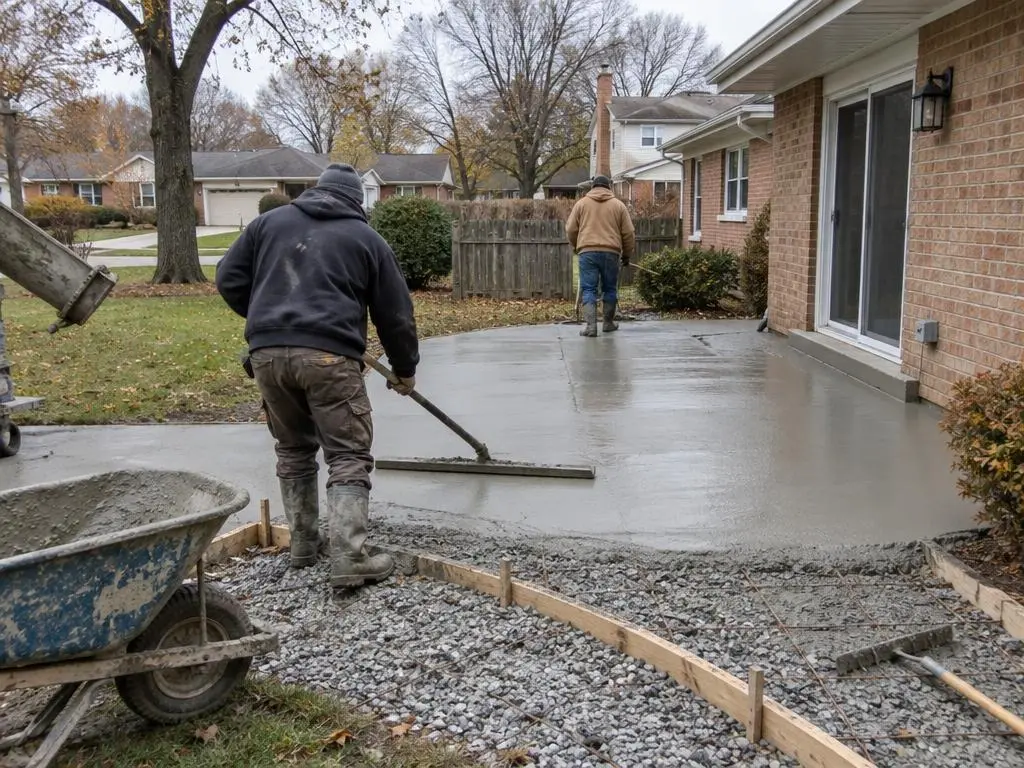
- Compacted stone base, planned joints and a proper cure on each slab
Clay, Brick and Older Homes
Park Ridge is one of the oldest towns around Arlington Heights. It incorporated in 1873, and in 1854 George Penny set up a brickworks there. According to Wikipedia, the ground is full of clay, which turned the area into a source of brick for a growing Chicago and gave it the name Brickton. For concrete contractors in Park Ridge, that clay and the age of the houses on top of it shape nearly every job.
Why clay matters under a slab
Clay holds water. When it is wet it swells, and when it dries it shrinks. In winter, water held near the surface freezes and lifts whatever sits on it. A driveway or walk poured directly on clay, or on a thin skim of gravel, moves with the soil every season. Over decades that shows up as tilted sidewalk squares, heaved driveway joints and stoops that have rocked toward the house.
The fix is not exotic. We dig out to a consistent depth, compact the subgrade, and put down a compacted gravel base thick enough to drain and spread the load. Where downspouts empty next to a walk or step, we deal with that water before we pour, because wet clay under new concrete is the start of the same problem all over again.
A town that filled in early
Park Ridge had 10,417 people by 1930 and 16,602 by 1950, then doubled to 32,659 in 1960 and reached 42,614 in 1970. The 2020 census counted 39,656 residents in 15,366 housing units. The population doubled during the 1950s alone, so a large share of homes went up in the years right after the war, and some are older still. Concrete around a house from that period has often been patched, overlaid or partly replaced more than once.
Working around older lots
The city's historic preservation commission keeps a list of historic landmarks and homes that are 100 years old or more, and older lots tend to come with mature trees and existing masonry. That affects how we work:
- Tree roots: cut cleanly and only where needed, after talking with you about the tree
- Access: tight side yards may call for wheelbarrows or a pump instead of a truck chute
- Long drives: a driveway that runs back to a rear garage can be replaced in sections
- Brick and stone: existing masonry steps, walls and edging are protected during the pour
Matching new concrete to an older house
New concrete is bright and gray next to aged brick. If you want it to sit more naturally, options include a light broom finish, an exposed aggregate surface, or stamped concrete with a color that picks up the brick. For front walks and steps on a traditional home, a simple border or a stamped band can make new flatwork look like it belongs.
Garage slabs on older lots
Where a garage sits at the end of a long drive, its floor is often thin and cracked, and some have settled toward the door so water runs in. We replace garage floors on compacted stone with a vapor barrier and air-entrained concrete, and we can pour a new apron at the overhead door so the transition is flush. The Des Plaines River, which separates Park Ridge from Des Plaines, is a reminder that water decides how long concrete lasts; we pitch every slab to send it away from the house.
Services for Park Ridge
- Sidewalks & steps for prewar and 1950s homes
- Concrete driveways, including long drives to rear garages
- Garage & shed slabs
- Concrete patios and stamped concrete
- Concrete repair & replacement on clay soil
We confirm permit needs with the city before scheduling. Call (224) 494-2266 for a free estimate.
Park Ridge Background
- Clay country. Wikipedia says the area's clay deposits made it a brick-making center for Chicago, beginning with George Penny's 1854 brickworks.
- Early growth. The population reached 16,602 by 1950 and doubled to 32,659 by 1960, peaking near 42,614 in 1970.
- Housing count. The 2020 census counted 15,366 housing units in Park Ridge, with a homeowner vacancy rate of just 1.1%.
- Incorporated. Park Ridge incorporated in 1873, earlier than most suburbs around Arlington Heights.
Our Services in Park Ridge, IL
Park Ridge Questions
Why do sidewalks and driveways in Park Ridge heave so much?
Clay soil swells when wet and lifts when frozen. Slabs poured with little or no gravel base move with it. A compacted gravel base and good drainage reduce that movement.
Can you replace a driveway without hurting my old trees?
We plan the excavation to limit root cutting and talk with you before cutting any large roots. Sometimes a slight change in the driveway edge or a thicker slab over a root zone is the better option.
Can new concrete match my older brick home?
It will not match exactly, but color, exposed aggregate or a stamped border can help it blend. We show options before you decide.
Free Estimates in Park Ridge, IL
Free concrete estimates in Park Ridge.
Concrete Contractors Near Park Ridge
- Concrete Contractors in Arlington Heights, IL
- Concrete Contractors in Mount Prospect, IL
- Concrete Contractors in Palatine, IL
- Concrete Contractors in Rolling Meadows, IL
- Concrete Contractors in Prospect Heights, IL
- Concrete Contractors in Buffalo Grove, IL
- Concrete Contractors in Wheeling, IL
- Concrete Contractors in Des Plaines, IL
- Concrete Contractors in Elk Grove Village, IL
- Concrete Contractors in Schaumburg, IL
- Concrete Contractors in Hoffman Estates, IL
- Concrete Contractors in Glenview, IL
- Concrete Contractors in Northbrook, IL
- Concrete Contractors in Barrington, IL
- Concrete Contractors in Streamwood, IL
- Concrete Contractors in Lake Zurich, IL
- Concrete Contractors in Inverness, IL
- Concrete Contractors in Long Grove, IL
- Concrete Contractors in Niles, IL
- Concrete Contractors in Vernon Hills, IL
- Concrete Contractors in Deerfield, IL
- Concrete Contractors in Lincolnshire, IL